What Are the PDPA Compliance Requirements Every Singapore Business Must Meet in 2026?
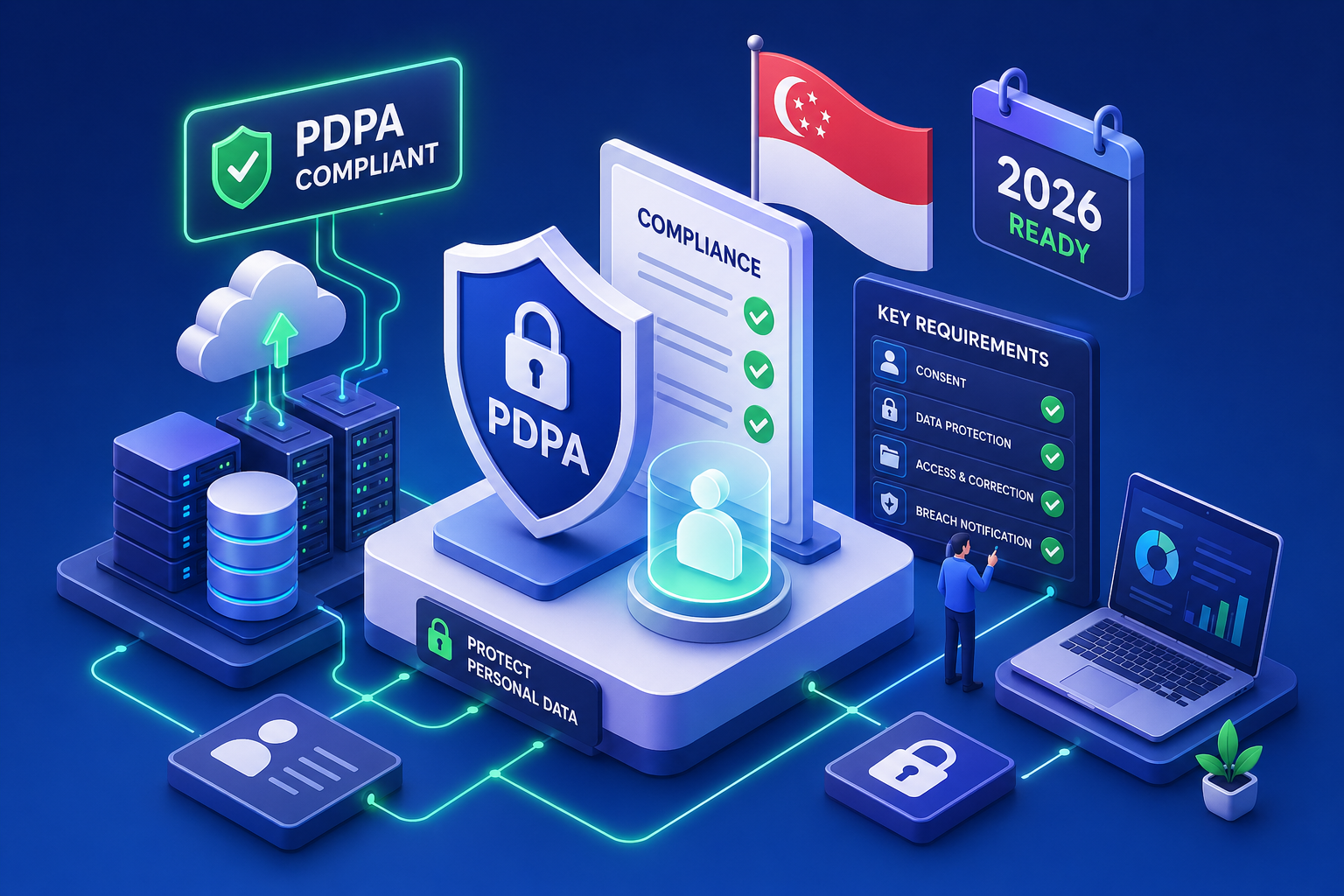
What are the PDPA compliance requirements every Singapore business must meet in 2026? Singapore's Personal Data Protection Act places nine binding obligations on every organisation — plus a mandatory DPO, a three-day breach notification rule, and a 31 December 2026 NRIC authentication deadline.
What are the PDPA compliance requirements every Singapore business must meet in 2026? The answer is more demanding than many organisations expect. Singapore's Personal Data Protection Act places nine binding obligations on every organisation that collects or handles personal data, and layered on top of those nine are additional requirements: a mandatory Data Protection Officer appointment, a strict three-day breach notification rule, and a hard 31 December 2026 deadline to stop using NRIC numbers for authentication. According to PDPC's published enforcement register, Singapore's PDPC investigated 185 cases and issued 58 decisions in 2025 alone, ordering 39 organisations to pay a combined S$1.7 million in financial penalties. That is not a quiet regulatory environment.
The organisations that drew fines were not reckless outliers. They were companies that failed to maintain active, documented security practices proportionate to the data they held. That pattern is worth paying close attention to.
This article walks through each PDPA requirement clearly, covers what has changed in 2026, and closes with a nine-point compliance checklist you can start acting on today.
PDPA compliance requirements for Singapore businesses in 2026: the nine obligations
These nine obligations form the non-negotiable foundation of PDPA compliance for Singapore businesses. They govern the full lifecycle of personal data, how you collect it, how you use it, how you protect it, and when you must delete it. The PDPA applies broadly to organisations conducting commercial activities in Singapore, with limited exemptions depending on specific facts and circumstances. Refer to the PDPC's published guidance on scope and exemptions to confirm your organisation's position.
Consent, purpose limitation, and notification
These three obligations work together at the point of data collection. Consent must be voluntary, informed, and specific, you cannot collect data for one reason and use it for another. Before collecting, individuals must be notified of the purposes and other relevant details. The PDPA amendments also introduced "deemed consent by contractual necessity," which applies when data collection is reasonably necessary to fulfil a contract the individual entered into (refer to PDPC's advisory guidelines on the PDPA amendments for the precise scope of this provision). This does not replace express consent; it supplements it in clearly defined circumstances.
Protection, retention limitation, and accuracy
The Protection Obligation requires reasonable security measures across physical, technical, and administrative dimensions. "Reasonable" is calibrated to risk, which means organisations holding large volumes of personal data face a higher standard of care. The Retention Limitation Obligation requires that data be deleted or anonymised once the purpose for which it was collected is fulfilled. The Accuracy Obligation goes further than passive storage: organisations must take active steps to ensure data remains correct and complete.
Access, correction, and accountability
Individuals have the right to request access to their personal data and to have inaccuracies corrected. Under the PDPA, organisations are generally expected to respond to these requests in a timely manner; check the PDPC's advisory guidelines for the applicable timeframes and any circumstances that may affect them. The Accountability Obligation ties everything together: it requires you to demonstrate compliance through documented policies, staff training records, and internal governance, not simply claim it. This is the obligation that separates organisations with real programmes from those running on good intentions.
Your DPO's role and what the accountability obligation demands in practice
Every organisation subject to the PDPA must appoint a Data Protection Officer, and that DPO's contact details must be publicly accessible, typically on your website. The DPO is the person who operationalises the Accountability Obligation day to day. The role can be filled by an internal staff member or outsourced to a qualified external party; what matters is that responsibilities are clearly assigned and actively fulfilled.
What the DPO is responsible for
The DPO's core duties cover a wide operational scope: overseeing PDPA compliance across the organisation, managing breach detection and response, conducting data protection impact assessments, handling individual access and correction requests, training staff, and serving as the primary point of contact with the PDPC. This is not an honorary role. A DPO who lacks authority, resources, or organisational access cannot fulfil these functions, and that gap shows up in enforcement decisions.
Building a data protection management programme
A Data Protection Management Programme (DPMP) is the structured framework that converts the Accountability Obligation into documented, repeatable practice. It encompasses your data inventory, internal policies, staff training schedule, vendor and third-party management controls, and regular review cycles. The PDPC's own guidance and the Data Protection Trustmark both reference the DPMP as evidence of mature governance. Organisations without a documented DPMP are not just exposed to regulatory risk, they also lack the operational infrastructure to detect and respond to incidents before they escalate. For additional practical considerations on aligning organisational controls with Singapore requirements, see this overview of Singapore data privacy compliance considerations.
Data breach notification: the 3-day rule and what it actually requires
Mandatory breach notification sits among the most operationally demanding PDPA compliance requirements for Singapore businesses. The timelines are strict, the assessment burden rests entirely on the organisation, and failure to comply is itself a breach of the Act, which means the notification process must be built into your incident response procedures before a breach occurs, not improvised during one. For a practical step‑by‑step reference on preparing notifications and the information to include, consult this Singapore data breach notification guide.
When a breach becomes notifiable
A breach triggers mandatory PDPC notification when it meets one of two independent thresholds. The first: the breach is likely to result in significant harm to affected individuals, including financial loss, identity theft, or reputational damage. The second: the breach affects 500 or more individuals, regardless of whether significant harm is likely. Both thresholds apply independently, a breach affecting 600 individuals with low individual harm is still notifiable.
The 3-day clock and what to include
The three calendar-day window begins from the moment the organisation determines the breach is notifiable, not from when it was discovered. However, the PDPC expects the full assessment to be completed within 30 days of discovery, and organisations taking longer face additional scrutiny. The notification must include a description of the breach, the data types affected, the number of individuals impacted, containment steps taken, and the DPO's contact details. If the investigation is still underway, organisations can submit available information and supplement it as the picture becomes clearer. Where significant harm is likely, affected individuals must also be notified directly, as soon as practicable.
Cross-border data transfers and the 2026 NRIC authentication deadline
Approved mechanisms for cross-border data transfers
Transferring personal data overseas requires that the recipient provides a standard of protection comparable to Singapore's PDPA. The primary approved mechanisms are: contractual Data Transfer Agreements (DTAs) that bind offshore recipients to PDPA-equivalent safeguards; Binding Corporate Rules (BCRs) for intra-group transfers across a corporate family; and ASEAN Model Contractual Clauses, which are designed for ASEAN-region transfers and are explicitly compatible with Singapore's PDPA framework. Singapore also participates in the APEC Cross-Border Privacy Rules (CBPR) System, which provides a recognised baseline for cross-border data flows and can complement contractual arrangements. For a detailed breakdown of accepted cross-border data transfer mechanisms under the PDPA, review the practical options and when each is appropriate. For cloud providers specifically, ensure the data protection terms are reviewed against your PDPA obligations and renegotiated where necessary.
The NRIC authentication ban: deadline 31 December 2026
From 1 January 2027, the PDPC will enforce penalties against organisations still using full or partial NRIC numbers as passwords, login IDs, or default authentication credentials. The basis is straightforward: static identifiers like NRIC numbers fail the "reasonable security measures" standard under the Protection Obligation. Any system that relies on NRIC-based authentication must be audited and migrated to alternatives before the 31 December 2026 deadline. This includes HR systems, customer portals, healthcare platforms, and any other service that uses NRIC as a credential in any combination. The transition work required should not be underestimated, organisations with legacy systems should begin immediately. For the official sector guidance and implications for private organisations, see this advisory on the requirement to cease use of NRIC numbers for authentication by 31 December 2026.
What recent PDPC enforcement actions reveal about compliance gaps
The enforcement record from 2025 and early 2026 makes the regulatory risk concrete. People Central Pte Ltd was fined SGD 17,500 in January 2026 after a breach exposed data belonging to 95,000 individuals, with that data likely surfacing for sale on the dark web. In April 2025, Singapore Data Hub Pte Ltd received the same penalty following a breach affecting 689,000 individuals. Marina Bay Sands Pte Ltd faced a significantly heavier consequence, a S$315,000 fine in October 2025, for inadequate security arrangements that allowed a misconfiguration error to cause harm at scale. For further reporting and analysis of these types of PDPC enforcement outcomes, see coverage of recent PDPC fines and enforcement actions.
What "reasonable security measures" looks like under scrutiny
The pattern across these decisions is consistent: organisations failed to conduct regular security reviews, vulnerability assessments, and penetration testing, even while holding tens of thousands or hundreds of thousands of personal data records. PDPC's decisions signal clearly that proportionality matters. The higher the volume of personal data you hold, the more rigorous your security programme must be, and the more thoroughly you must document it. Organisations that cannot demonstrate active, ongoing oversight of their security posture are the ones appearing in enforcement decisions. A reactive posture is not a defence.
Turning these requirements into a compliance action plan
The PDPA compliance requirements Singapore businesses face in 2026, the nine obligations, the DPO mandate, breach notification rules, cross-border controls, and the NRIC deadline, combine into a demanding but manageable picture, provided you approach it systematically. The following nine priority actions give you a structured roadmap for the remainder of the year.
Top PDPA compliance checklist items for 2026
-
Confirm or appoint a DPO with publicly accessible contact details on your website.
-
Complete a personal data inventory across all systems, including third-party platforms and cloud environments.
-
Audit and update consent notices to ensure they are specific, voluntary, and clearly state the purpose of collection.
-
Document the purposes for every category of personal data your organisation collects and uses.
-
Build or formalise your DPMP with documented policies, training records, and regular review cycles.
-
Implement a breach detection and notification procedure that includes internal escalation steps, assessment criteria, and the PDPC notification process.
-
Review all cross-border data transfer arrangements and ensure appropriate DTAs, MCCs, or BCRs are in place.
-
Migrate away from NRIC-based authentication across all systems before 31 December 2026.
-
Run regular security reviews and penetration testing calibrated to the volume and sensitivity of data your organisation holds.
How a data resilience assessment supports PDPA compliance evidence
The Protection and Accountability Obligations require organisations to demonstrate active governance, not simply assert it. Documented evidence of due diligence is what separates an organisation that passes PDPC scrutiny from one that draws a direction or a fine. A structured assessment is one of the most direct ways to generate that evidence.
One structured option worth naming specifically: Reach Pte. Ltd.'s data resilience assessment maps your organisation's technical posture across nine resilience domains, translates identified gaps into financial risk and regulatory exposure, and produces board-ready reports with documented evidence of due diligence. For DPOs and compliance officers who need auditable proof that their organisation is meeting the Protection Obligation standard, the assessment is designed to deliver that documentation efficiently, at a fraction of the cost of a full consulting engagement, with outputs suitable for internal governance review, board reporting, and PDPA compliance records.
The compliance picture for 2026, and what to do with it
Understanding what are the PDPA compliance requirements every Singapore business must meet in 2026 is the first step, acting on them is the work. The nine obligations, the DPO mandate, breach notification rules, cross-border controls, and the NRIC authentication deadline are not abstract legal language. They translate directly into operational processes, documented evidence, and technical controls that either exist in your organisation or do not.
Organisations that approach compliance proactively, with structured assessments, clear ownership, and regular review cycles, are the ones that hold up when PDPC comes looking. Those that treat it as a checkbox exercise are the ones generating enforcement decisions. The 2025 and 2026 track record makes that distinction unmistakable.
Start with the nine-point checklist above. Assign your DPO. Document your DPMP. Make sure your protection measures can withstand scrutiny. And if you need an objective view of where your organisation stands across all nine resilience domains, Reach Pte. Ltd. has the tools and expertise to get you there. Take The assessment now!