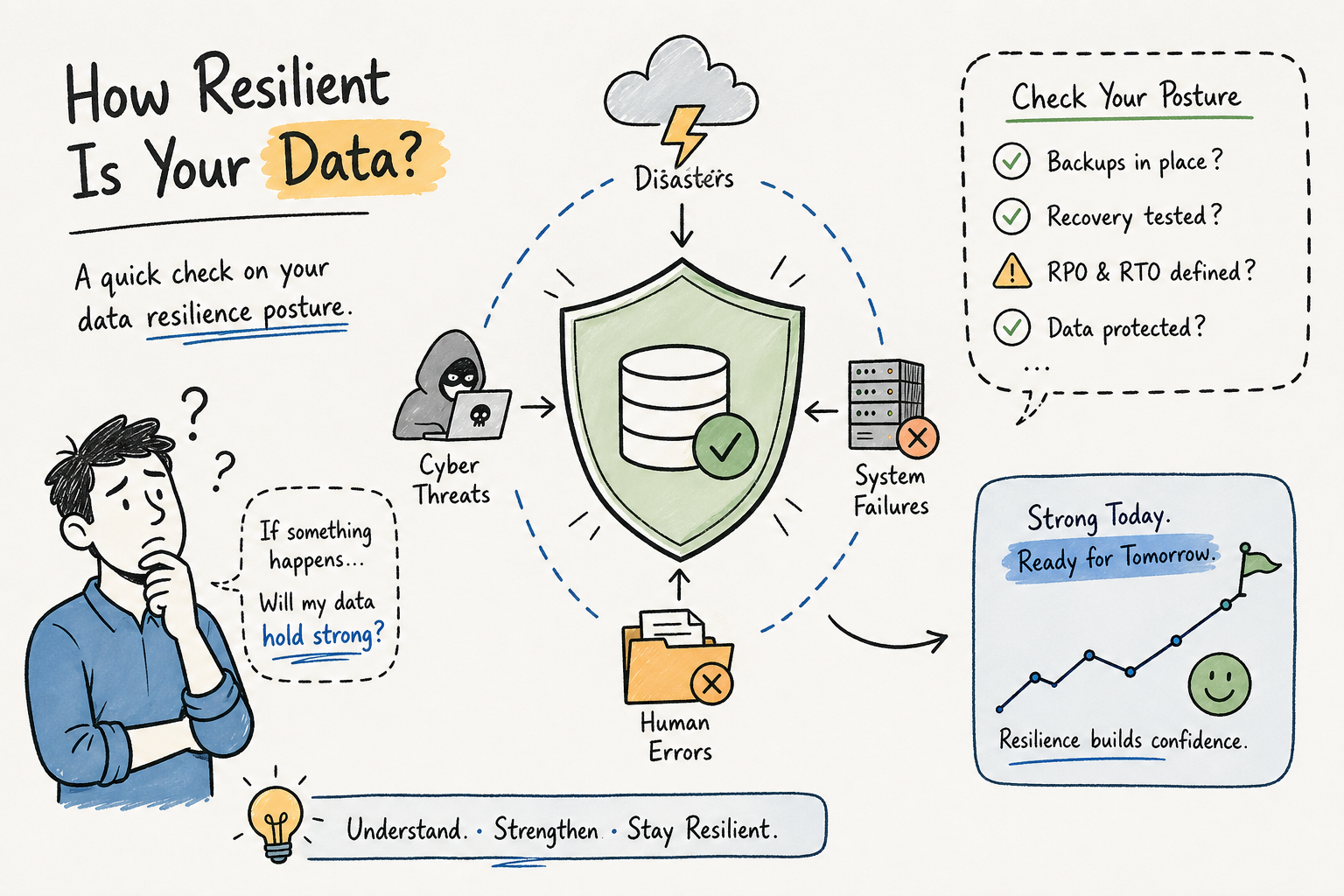
Do you understand your data resilience posture?
Most enterprises assume their backups and DR plan are enough. A structured data resilience gap analysis usually proves otherwise — here's what a genuine assessment covers across nine domains, and how to turn the findings into a funded remediation roadmap.
Many Singapore enterprises operate on a quiet assumption: backups are running, a DR plan lives somewhere on a shared drive, and that's enough. A structured data resilience gap analysis for Singapore enterprises tells a very different story. The Veeam Data Protection Trends Report (2024) and McKinsey's research on enterprise resilience maturity both point to the same finding, 74% of enterprises score in the two lowest maturity horizons, and only half consistently meet their recovery time objectives during actual disruptions. The gap between assumed resilience and verified resilience is precisely where organisations get hurt.
This article walks enterprise leaders and resilience teams through what a genuine data resilience assessment involves, which domains it must cover in a Singapore regulatory context, and how to translate findings into a prioritised remediation roadmap with clear owners and measurable outcomes. If your organisation has completed a gap analysis recently, use this as a benchmark. If it hasn't, treat it as the brief that gets one started.
What a data resilience gap analysis actually tells you
A data resilience assessment is not a backup audit or a compliance checklist. It is a structured evaluation of your organisation's ability to protect data, sustain operations, and recover across every operational and regulatory dimension that matters. The output is a domain-by-domain maturity score paired with a financial risk exposure figure, showing leadership exactly where the gaps sit and what they cost if left unaddressed.
The distinction matters because backup audits confirm that jobs ran. A proper gap analysis asks whether the data those jobs captured can actually be recovered, at speed, under adversarial conditions, without triggering a regulatory breach. Most organisations have answered the first question thoroughly and left the second largely untouched.
Singapore's regulatory landscape has tightened considerably. IMDA's February 2025 Advisory Guidelines for Data Centre Resilience, the MAS Technology Risk Management framework, and PDPA obligations all place specific, documented expectations on how organisations manage continuity, cybersecurity risk, and governance oversight. A structured gap analysis creates the auditable evidence that regulators and boards increasingly expect, not a verbal assurance that everything is in order.
Data resilience gap analysis: nine domains Singapore enterprises must cover
An enterprise-grade assessment needs to evaluate backup architecture and policy, disaster recovery readiness, data replication and continuity, and cybersecurity controls including ransomware resilience and immutable backup capabilities. These domains address the foundational question of whether your organisation can actually recover, not merely whether recovery procedures exist on paper. DR readiness in particular should be tested against documented RTO and RPO targets, not assumed ones.
Three areas that organisations consistently underestimate are data governance gaps, data sprawl and visibility, and emerging GenAI data controls. Research on enterprise resilience highlights all three as frequently under-addressed. Data governance failures introduce regulatory exposure under PDPA. Uncontrolled data sprawl, accelerated by cloud adoption and shadow IT, creates recovery blind spots that don't surface until an incident reveals them. GenAI workloads introduce new attack surfaces and data leakage vectors that traditional frameworks weren't designed to handle. Any assessment that ignores these three areas will produce an incomplete picture of actual risk posture.
The final layer covers data continuity and recovery processes alongside people and process factors: incident response readiness, role accountability across board, C-suite, and operational teams, and alignment with applicable frameworks such as MAS TRM and CSA guidelines. Reach Pte. Ltd. structures its assessment across all nine of these domains, producing a severity-rated gap view that covers both technical and organisational dimensions in a single pass, described by Reach as delivering a complete picture rather than a selective one.
How to score maturity and quantify your financial exposure
Resilience maturity models typically place organisations on a four-level spectrum: Basic (reactive and manual), Intermediate (more reliable but fragmented), Advanced (strategic and proactive), and Best-in-Class (AI-optimised and autonomous). Scoring your organisation honestly against clear descriptors for each level, supported by evidence from policies, test results, and data coverage metrics, reveals not just where you are but how far you are from where regulatory and operational demands require you to be.
The most powerful output of a gap analysis is not the maturity score. It is what each gap costs the business in quantifiable risk exposure. Converting technical deficiencies into financial terms, estimated breach cost, regulatory penalty exposure under PDPA, and operational downtime value, transforms a resilience report into a board-ready investment case. A list of technical findings rarely moves budget; a financial risk figure attached to each gap often does. The translation is what gets remediation funded.
Reach's AI-powered platform is designed to perform this translation automatically, assigning financial risk values to each identified gap so that remediation decisions can be grounded in business impact rather than technical intuition. For Singapore organisations operating under PDPA, where breach penalties and reputational damage are well-documented, this financial framing gives DPOs and CISOs the language they need in front of a board.
Turning findings into a prioritised remediation roadmap
A gap analysis output loses its value when it produces a 40-item list with no clear sequence. A practical remediation approach organises fixes across three time horizons. Quick wins in the first 60 days target high-severity, low-complexity gaps that can be closed immediately. A focused improvement cycle over 13 weeks addresses mid-tier gaps that require process or tooling changes. A 12-month strategic programme handles systemic issues such as DR architecture redesign or governance model overhaul. This cadence keeps teams moving without overwhelming them.
Remediation only works when every action has a named owner at the right level of the organisation. Board-level owners are accountable for risk appetite decisions and investment sign-off. C-suite owners, typically the CTO, CISO, or DPO, are responsible for programme direction and regulatory representation. IT and architecture teams own execution. Defining this accountability at the point of gap discovery, not weeks later in a steering committee, is what separates organisations that close gaps from those that document them and move on.
Prioritisation should weigh five filters consistently: severity and risk level, business impact on critical services and data, regulatory urgency tied to MAS TRM or PDPA timelines, resource requirements, and implementation complexity. Applied consistently, these filters ensure that the gaps most likely to cause harm get addressed first, not the ones that happen to be the easiest to fix.
KPIs and tests that prove your fixes are working
Core operational metrics
Tracking remediation effectiveness requires a focused set of operational and recovery KPIs. Four metrics matter most: backup success rate (the percentage of verified, clean, usable backups), recovery time in DR drills versus documented RTO, mean time to detect and mean time to respond for security incidents, and data integrity confidence measured through test-restore pass rates. Tracked over time, these tell you whether your maturity score is genuinely improving or just sitting in a report. For further guidance on practical KPI sets and how to measure them in production, see resources on measuring resilience KPIs that go beyond uptime.
Executive and operational views
Executives need a composite continuity assurance score that weights recovery speed, data loss avoidance, and procedure execution. One common approach weights these at 50%, 30%, and 20% respectively, adjusted for the organisation's specific risk profile. Operational teams need the underlying metrics surfaced when they trend negatively, so problems become visible before they escalate into incidents.
Test cadence and audit evidence
KPIs are only meaningful if the underlying tests happen consistently. Data backup and recovery programme assessments should run quarterly. Technology and DR readiness assessments should run twice a year. Corporate-level risk assessments align to semi-annual cycles. Each test produces documented evidence that satisfies audit requirements under MAS TRM and PDPA obligations, and feeds back into the gap analysis to show whether maturity scores are improving over time. Without this feedback loop, you're reporting history rather than managing risk.
How Reach's AI-powered assessment makes this practical
Traditional enterprise gap analysis exercises take weeks and significant consulting budget to complete. The typical approach involves engaging a consultancy, scheduling workshops, waiting for a report, and then finding that the findings are already six weeks old by the time they're delivered. For Singapore enterprises that need to demonstrate active governance to regulators now, that timeline is a liability.
Reach Pte. Ltd. addresses this with a self-serve, AI-guided assessment designed to cover all nine resilience domains in a single session. The platform is built to produce domain-by-domain maturity scores, severity-rated gap analysis, financial risk exposure quantification, and structured action plans, all packaged in a board-ready executive report suitable for senior leadership, audit trails, and compliance documentation.
What separates Reach's platform from a generic compliance checklist is the AI-powered remediation prioritisation layer. Rather than presenting a flat list of findings, the system is designed to rank gaps by business impact and urgency, surfacing the fixes that will deliver the greatest risk reduction first. For Singapore organisations operating under PDPA, MAS TRM, and IMDA guidelines, Reach states that this prioritisation is calibrated to local regulatory expectations, giving DPOs, CISOs, and IT directors a defensible roadmap they can act on. Pricing starts at $9.50 per month with no long-term commitment.
Your posture is only as good as your last honest assessment
Understanding your data resilience posture is not an academic exercise. For Singapore enterprises, it is the difference between demonstrating credible governance to regulators and being exposed when an audit, incident, or board question arrives without warning. The consequences range from regulatory penalties under PDPA to reputational damage that outlasts the incident itself.
A rigorous assessment structured across the right domains, translated into financial risk terms, converted into a sequenced remediation roadmap with clear ownership and measurable KPIs, is the mechanism that makes resilience real rather than assumed. According to the Veeam Data Resilience Maturity Model and McKinsey DRMM research, 74% of organisations score in the two lowest maturity horizons. The interpretive question that follows is a practical one: do you know where your organisation sits, or are you relying on the same assumption that the data consistently disproves?
If your organisation hasn't completed a data resilience gap analysis for Singapore enterprises recently, or at all, the practical starting point is a tool that covers every domain that matters and produces outputs your board can act on. Reach Pte. Ltd. was built specifically for that moment. Start your assessment today before your next MAS audit surfaces gaps you haven't yet seen.