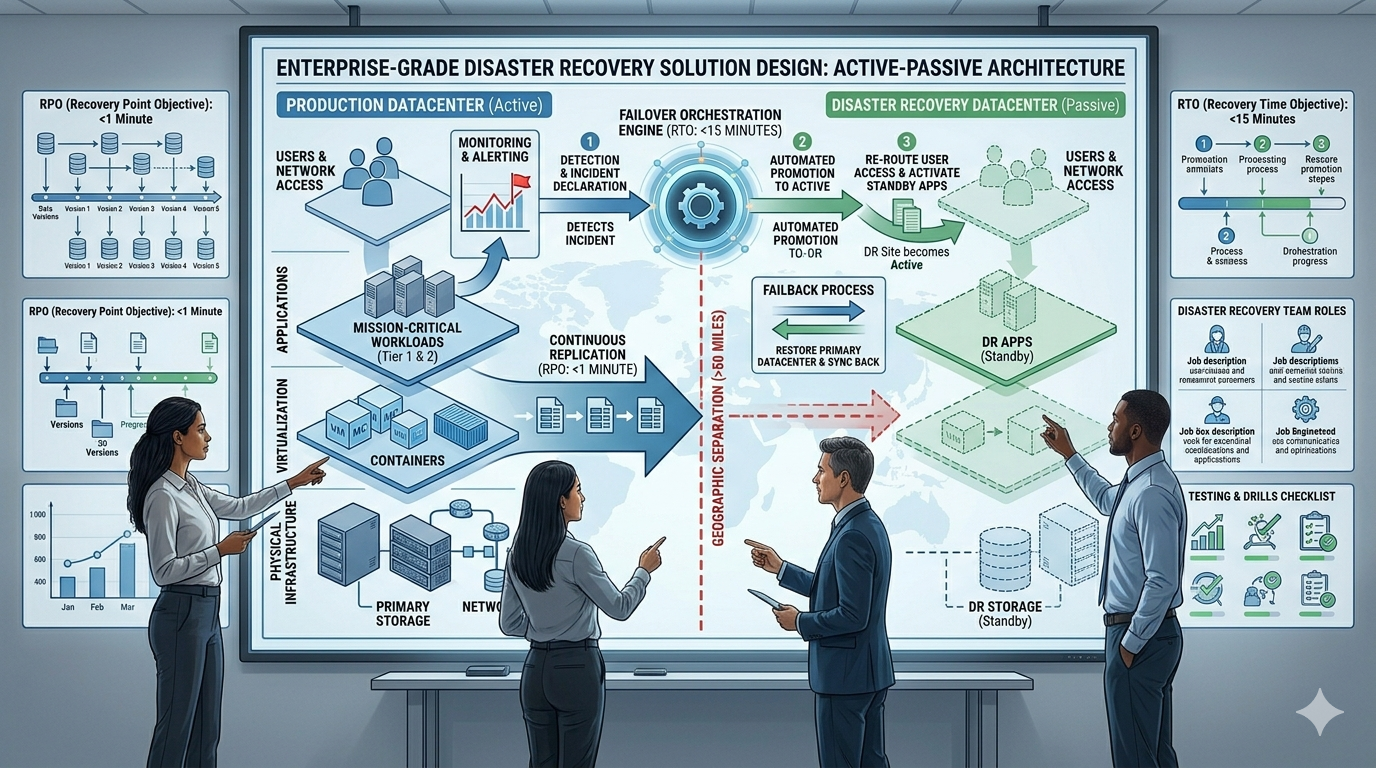
Designing a modern disaster recovery solution for your business
Most DR plans were designed for the infrastructure of a decade ago. Tiering, four architecture patterns, and a four-phase design process for the modern estate.
Definition
Disaster recovery — the discipline of designing, documenting, and rehearsing the technical and operational steps required to bring critical business systems back online after a disruptive event, within a defined window of time and to a defined point of data freshness.
Most disaster recovery solutions in use today were designed for the infrastructure of a decade ago — on-premises servers, a single corporate data centre, staff who worked from the same office every day. Modern businesses operate across cloud platforms, hybrid infrastructure, dozens of SaaS applications, and a distributed workforce. A modern DR solution has to be designed for the way the business actually works today.
The modern DR challenge
Cloud workloads
Snapshots are not disaster recovery. A snapshot sits in the same cloud account and blast radius as the workload it protects. Cross-region copies, immutable object versions, and account isolation are different disciplines.
SaaS dependencies
Microsoft 365, Salesforce, Xero offer availability SLAs, not DR SLAs. Under every shared responsibility model, the data is the customer's responsibility. A DR design that does not cover SaaS data has a hole the size of the business.
Distributed workforce
A DR plan that assumes staff can reach a recovery site in 30 minutes is not a DR plan for a business spread across cities. Recovery procedures must be re-engineered as remote-first.
Ransomware as a DR event
Now the most common DR trigger for organisations of all sizes. Recovery means rebuilding into a clean environment from a copy the attacker could not reach.
DR architecture options
Cold standby
Lowest cost, longest recovery, hours to days. Appropriate for non-critical systems.
Warm standby
Pre-provisioned and reasonably current, not serving traffic. Recovery in hours. The most common mid-tier choice.
Hot standby
Running, near-real-time data sync. Recovery in minutes. For business-critical systems.
Active-active
Both sites serve production simultaneously. RTO and RPO close to zero. Highest cost; for mission-critical systems only.
Closing
Disaster recovery design is not a one-time event. It is a living architecture that must be reviewed as the business changes, as the threat landscape evolves, and as new systems and dependencies are introduced. The organisations with the most effective DR designed deliberately, tested honestly, and improved continuously — treating DR as a capability to be earned rather than a product to be bought.
Want a complete picture of your resilience posture?
The Reach Data Resilience Assessment evaluates your DR readiness alongside your data protection and backup posture.
Start your free assessment →